Prep · 10 min read
Your first prenatal appointment: what to expect, bring, and ask.
The longest, most information-packed appointment of your entire pregnancy. Here's how to walk in calm and walk out informed — not overwhelmed.
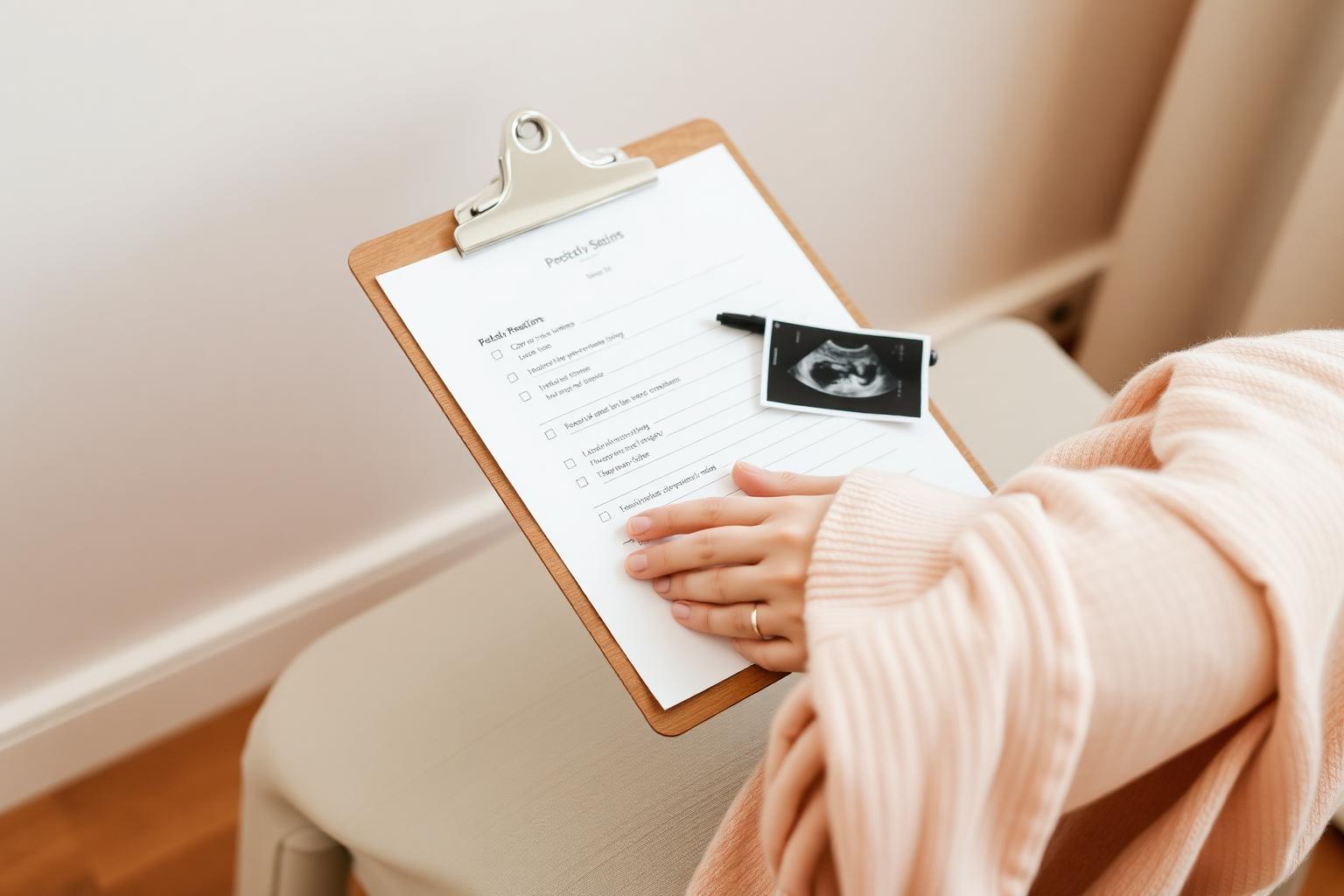
Your first prenatal appointment is the longest appointment of the entire pregnancy. You'll be in the office for 60 to 90 minutes, you'll get more information in one sitting than at any visit afterward, and you'll likely hear your baby's heartbeat for the first time. Most moms walk in nervous and walk out exhausted, emotional, and quietly proud.
This is the calm playbook — exactly what to expect, what to bring, what your OB will do, and the 18 questions worth asking while you have their attention. Bookmark it, save it to your first trimester checklist, or load it into The Calm Pregnancy System™ appointment tab.
1. When the first appointment happens
Most OBs and midwives schedule the first visit between weeks 8 and 10. Before week 8, ultrasounds often can't see much, and you miss the chance to hear a heartbeat — a major reason most moms book this window. After week 10, you risk missing the timing window for NIPT (week 10) and the early genetic screening conversation.
Book the appointment as soon as you get a positive test. In most US cities, new-patient slots are 4–6 weeks out. If you have a history of miscarriage, IVF, pre-existing diabetes or thyroid disease, or are over 35, your OB may want to see you sooner — say so when you call.
2. What to bring (and what to skip)
Bring:
- Your ID and insurance card.
- A list of every medication, supplement, and vitamin you take — including dose.
- Your family medical history (yours, your partner's, and both sets of grandparents if you have it).
- The first day of your last menstrual period.
- A printed or saved list of your questions (see Section 5).
- A notebook or your phone to take notes — there is too much to remember.
- A snack and water bottle. Most first visits include fasting labs OR run long.
- Your partner, if possible — a second set of ears matters.
Skip:
- A 4-page birth plan. You'll write that in trimester two with real information.
- Specific questions about which stroller to buy. Save those for week 22.
- Anxiety about "asking too much". This is the longest visit you get — use it.
3. What actually happens at the visit
The standard first prenatal appointment has six parts, usually in this order:
1. Intake paperwork (15–25 min)
You'll fill out a long medical history form — your conditions, surgeries, mental health history, family history, partner's family history, lifestyle (alcohol, smoking, drug use, exercise), and previous pregnancies if any. Be honest. Your OB has heard everything, and accuracy here keeps you safe.
2. Vitals and weight
Blood pressure, weight, height, and a urine sample. The urine sample checks for protein, sugar, and infection — and you'll do one at every single visit going forward.
3. Physical exam
A general physical, breast exam, and often a Pap smear if you're due for one. Some OBs do a pelvic exam at this visit; others wait. Speak up if anything is uncomfortable.
4. Ultrasound (the magic part)
If you're 8+ weeks, your OB will usually do a transvaginal ultrasound — a small wand inserted vaginally, not the belly gel kind you've seen in movies. The baby is still too small to see well from the outside. You'll see a tiny flickering spot: that's the heartbeat. It typically beats 120–170 bpm and sounds like a fast galloping horse. Most moms cry. Bring tissues.
5. Blood draw
The longest blood draw of your pregnancy — usually 4 to 8 vials. See section 4 for what they're checking.
6. The conversation
Your OB will calculate your due date, walk through what's safe and what isn't, explain their visit schedule for the next 32 weeks, and answer your questions. This is the part most moms wish they'd prepared for — see Section 5.
4. The blood work, explained
Standard first-trimester labs check:
- Blood type and Rh factor (matters if you're Rh-negative — you'll need a RhoGAM shot later).
- Complete blood count (checks for anemia — extremely common in pregnancy).
- Blood sugar baseline (to compare against your glucose test at week 28).
- Thyroid panel (thyroid issues affect baby's brain development).
- Immunity to rubella, varicella (chickenpox), and sometimes measles.
- Hepatitis B and C, HIV, syphilis (required by law in most US states).
- Urine culture for asymptomatic bacterial infection (treating prevents preterm labor).
Most practices also offer two optional add-ons: NIPT (non-invasive prenatal testing) for chromosomal conditions from week 10, and carrier screening for conditions like cystic fibrosis and sickle cell. These can cost out-of-pocket — ask about the price before you consent.
5. The 18 questions worth asking
Bring this list. Use whichever applies. Cross out the rest.
About your care
- Who delivers my baby if you're not on call?
- How many appointments will I have, and when?
- What's your hospital and is it in-network?
- Who do I call after hours for urgent questions?
- Do you support a birth plan? Are there things you don't do?
About testing
- Do you recommend NIPT, and is it covered by my insurance?
- What carrier screening do you offer?
- When will the anatomy scan happen, and can I find out the gender?
About my body & lifestyle
- Are any of my current medications or supplements unsafe?
- Which prenatal vitamin do you recommend?
- Are there exercises I should avoid?
- What's safe to eat — and what should I really avoid?
- How much weight gain is healthy for my starting body?
About symptoms & emergencies
- What symptoms should make me call you right away?
- Is the nausea I'm having normal? What can I take?
- Can I take Tylenol, Tums, or Benadryl?
- When should I go to L&D vs. wait until office hours?
- What perinatal mental health resources do you recommend if I need them?
6. What to do after the appointment
- Write down your due date, the heartbeat number, and your next appointment date.
- Print or save the ultrasound photo somewhere safe (these get lost easily).
- Update your prenatal vitamin if your OB recommended a switch.
- Note any prescriptions and pick them up that day.
- Eat something — emotional appointments deplete you more than physical ones.
- Log everything in your planner so the next visit isn't starting from scratch.
- Tell your partner the parts they missed (or replay your phone recording together).
7. Frequently asked questions
When is the first prenatal appointment usually scheduled?+
Most OBs see new patients between weeks 8 and 10 of pregnancy. Earlier than 8 weeks, an ultrasound often can't see much yet; later than 10 weeks, you miss the window for NIPT and early genetic testing. If you have a history of miscarriage, IVF, or pre-existing conditions, your OB may see you sooner.
How long does the first prenatal appointment take?+
Plan for 60–90 minutes. It's the longest visit of your entire pregnancy because it covers your full medical history, a physical exam, labs, often an ultrasound, and a long conversation about what's ahead. Bring snacks and a partner if possible.
Will I get an ultrasound at my first appointment?+
Usually yes, if you're 8+ weeks along. It's typically a transvaginal ultrasound (a small wand, not the belly gel kind) because the baby is still tiny. You'll often hear the heartbeat for the first time — it sounds like a fast galloping horse.
What blood tests are done at the first prenatal visit?+
Standard first-visit labs include: blood type and Rh factor, complete blood count, blood sugar, thyroid panel, immunity to rubella and varicella, hepatitis B and C, HIV, syphilis, and a urine culture. Most practices also offer NIPT and carrier screening as optional add-ons.
Do I need to bring my partner to the first prenatal appointment?+
It helps but isn't required. There's a lot of information delivered fast, and a second set of ears is valuable. If your partner can't come, bring a notebook (or your planner) and ask if you can record the conversation on your phone.
Is it normal to feel nervous before the first appointment?+
Almost universal. You're walking into a room where someone will, for the first time, confirm everything is real and (hopefully) healthy. Most moms cry — happy tears, anxious tears, or both. Arrive 15 minutes early so you have time to breathe in the waiting room.
One calm place for every appointment
Never walk into another visit unprepared.
The Calm Pregnancy System™ holds every appointment, every question, every lab result and every note — for the next 32 weeks, in one beautiful Google Sheet.
Get The Calm Pregnancy System™✦ Instant access · Google Sheets · Lifetime updates